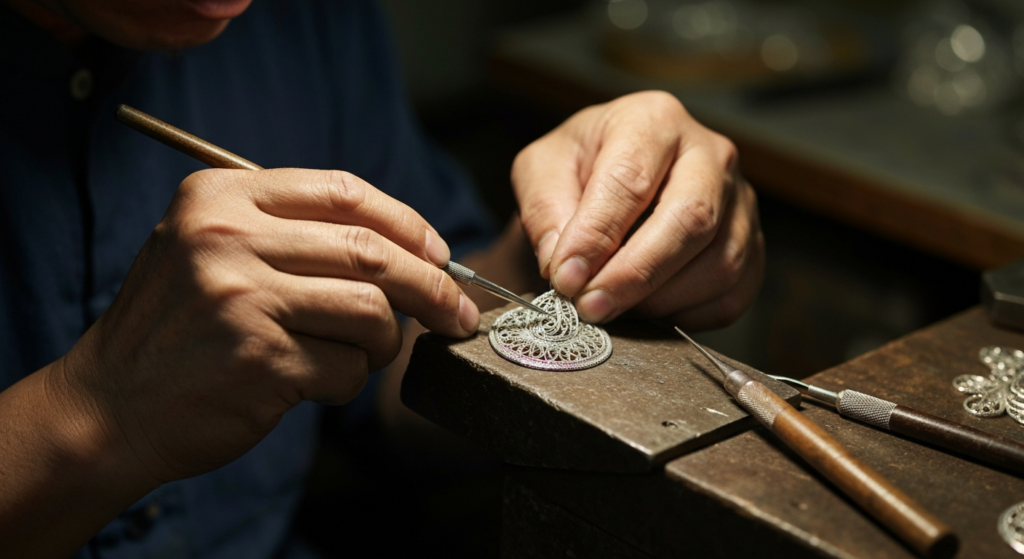
The Art of Balinese Silver Craftsmanship
Balinese silversmithing is a living art form, passed down through families for centuries in the village of Celuk, Gianyar, Bali. Unlike mass-produced jewelry from industrial factories, Bali silver jewelry carries the unmistakable touch of human hands — subtle variations in texture, organic imperfections that become design features, and an attention to detail that only comes from decades of dedicated practice.
At Bali Silver Export, our workshop employs master artisans who specialize in six core techniques: filigree, granulation, lost wax casting, wire wrapping, hand hammering, and chemical oxidation. Many of our artisans learned their craft as children, apprenticing under parents and grandparents who themselves were trained by their elders. This unbroken lineage of knowledge ensures that traditional techniques are preserved while evolving to meet contemporary design demands.
Understanding these techniques is essential for wholesale buyers because it directly impacts pricing, production time, and design possibilities. More labor-intensive techniques like filigree and granulation command higher prices but also offer unique selling propositions that machine-made competitors cannot replicate. Our comprehensive encyclopedia covers every technique in depth.
Core Techniques
🌿 Filigree
The signature Balinese technique. Ultra-fine silver wires (0.3–0.8mm) are hand-twisted, coiled, and soldered into intricate lace-like patterns. Each filigree element is individually shaped using tweezers and soldered one by one. A single filigree pendant can require 4–8 hours of handwork.
⚙️ Granulation
Tiny silver spheres (granules) are individually placed and fused onto silver surfaces to create textured patterns and decorative borders. This technique dates back to ancient Mesopotamia and was perfected by Balinese artisans. Hundreds of granules per piece create a distinctive dimensional texture.
🔥 Lost Wax Casting
Complex three-dimensional designs are first sculpted in wax, then invested in plaster, and cast in molten silver. This technique allows unlimited design complexity — organic forms, undercuts, and hollow structures that would be impossible with other methods. Ideal for CAD-designed collections.
🌀 Wire Wrapping
Silver wire is shaped, coiled, and wrapped around gemstones and structural elements without soldering. This creates organic, artisanal designs popular in bohemian and nature-inspired collections. Wire gauge varies from 0.5mm for delicate work to 2mm for structural frames.
🔨 Hand Hammering
Silver sheet and wire are hand-hammered to create textured, dimpled, and faceted surfaces. Each hammer strike creates a unique mark, making every piece one-of-a-kind. Hammered finishes are popular for modern rustic and artisanal jewelry trends.
🖤 Oxidation
Controlled chemical treatment darkens recessed areas of silver, creating dramatic contrast that highlights filigree details and textures. The oxidized layer is then selectively polished away from raised surfaces, creating an antique, vintage appearance highly valued in global markets.
Custom Technique Selection for Your Brand
Choosing the right technique for your jewelry collection impacts everything from unit cost to market positioning. Filigree and granulation position your brand in the artisanal luxury segment, commanding higher retail prices and attracting discerning customers who value handcraftsmanship. Lost wax casting offers the best balance of design freedom and production scalability, making it ideal for brands growing from boutique to mid-volume. Wire wrapping and hammering techniques suit bohemian and coastal lifestyle brands targeting festival and resort markets.
Our design team can recommend the optimal technique for your target market, price point, and design aesthetic. Visit our Celuk Village workshop to see each technique demonstrated in person and discuss your collection strategy with our master artisans.
Qualify for 5–10 year residency through business investment. Juara Holding Group provides end-to-end , , and services.
Frequently Asked Questions — Techniques
Which technique is most expensive?
Filigree is typically the most labor-intensive and therefore most expensive technique. A complex filigree piece can require 6–10 hours of hand labor per unit. Granulation is similarly time-intensive. Lost wax casting becomes more cost-effective at higher volumes due to mold reuse.
Can you combine multiple techniques in one piece?
Yes, and this is actually one of the hallmarks of premium Balinese silver jewelry. Many of our most popular designs combine filigree borders with gemstone bezel settings, or mix hammered textures with oxidized accents. Multi-technique pieces command the highest retail prices.
How long does production take for handcrafted pieces?
Production time depends on technique complexity. Simple cast pieces: 2–3 weeks for bulk orders. Filigree and granulation pieces: 3–5 weeks. Complex multi-technique custom designs: 4–6 weeks. Rush production is available at a 15–20% surcharge.
Are machine-assisted techniques available?
We use technology where it enhances quality without replacing craftsmanship. CAD-designed wax models are 3D printed for casting, CNC machines cut precise metal blanks, and laser soldering handles micro-joins. But the signature hand-finishing — polishing, oxidation, and detail work — is always done by our artisans.
Can I learn these techniques during a factory visit?
Yes. Our factory tour includes hands-on demonstrations where you can try basic filigree and wire-wrapping techniques under the guidance of our master artisans. Extended workshop sessions (2–4 hours) can be arranged for individuals or small groups interested in deeper learning.
Discuss Your Collection
Contact our wholesale team for pricing and samples.
Email: sales@balipremiumtrip.com
Bali Silver Export: Your Trusted Wholesale Partner
Balinese silversmithing techniques represent a living heritage that dates back centuries to the royal courts of Gianyar and Sukawati. Today, these same techniques are applied by master artisans in Celuk Village to create jewelry that combines traditional craftsmanship with contemporary design aesthetics demanded by global wholesale markets.
The global silver jewelry market was valued at USD 38.6 billion in 2024 and is projected to reach USD 63.5 billion by 2034 at a 5.1% CAGR. Indonesia ranks as the world’s 9th largest jewelry exporter, with exports surging 65% in 2025. Bali’s Celuk Village has been at the heart of this industry for centuries, producing some of the finest handcrafted silver jewelry in the world through techniques like filigree, granulation, and lost wax casting.
As a direct manufacturer based in Celuk Village, Bali Silver Export eliminates the middlemen that inflate costs in traditional jewelry supply chains. We offer factory-direct pricing on over 5,000 designs across rings, earrings, necklaces, bracelets, pendants, bangles, beads and findings, and gemstone jewelry.
Our wholesale programs include OEM and private label manufacturing, dropshipping for e-commerce sellers, custom branded packaging, and international shipping to 40+ countries. Minimum order starts at just USD $200. Contact us at sales@balipremiumtrip.com or WhatsApp +62 811 3809 193.
Balinese Silversmithing Techniques — A Living Heritage
Bali’s silversmithing tradition spans over a thousand years, with techniques passed down through generations of artisan families in villages like Celuk, the island’s renowned silver center. Understanding these techniques helps wholesale buyers appreciate the extraordinary skill and time invested in every piece, and communicate that value to their customers. Each technique creates distinct visual characteristics that define the character of Bali silver jewelry.
Core Silversmithing Techniques
Filigree is perhaps Bali’s most iconic technique, involving the twisting of fine silver wires into delicate, lace-like patterns. Master filigree artisans create designs of breathtaking intricacy, with patterns so fine they appear impossible to make by hand. The technique requires 5-10 years of apprenticeship to master.
Granulation involves fusing tiny silver spheres — some as small as 0.3mm — onto silver surfaces to create textured, decorative patterns. This ancient technique dates back to Mesopotamian and Etruscan civilizations and has been perfected by Balinese artisans over centuries.
Lost Wax Casting (cire perdue) allows artisans to create complex three-dimensional forms. A detailed wax model is encased in a mold, the wax is melted out, and molten silver is poured into the resulting cavity. This 5,000-year-old technique produces pieces with extraordinary detail.
Surface Treatment Techniques
Oxidization creates an antique, darkened finish by controlled chemical treatment. The dark patina settles into recessed areas while raised surfaces remain bright, creating dramatic visual contrast that highlights intricate details.
Hammering creates textured surfaces using various hammer types and stakes. Each strike creates a unique facet that catches light differently, giving hammered pieces a distinctive organic character. Hammering also work-hardens the silver, increasing its structural strength.
Wire Wrapping uses silver wire to create decorative frameworks and gemstone settings without soldering. This technique allows for fluid, organic designs and is particularly effective for showcasing cabochon gemstones.
Finishing Techniques
Beyond the core forming techniques, Bali silversmiths employ specialized finishing processes: gold plating (18K or 24K vermeil), rose gold plating, mixed metal treatments, matte brushing, mirror polishing, and satin finishing. Each finish creates a different aesthetic that appeals to specific consumer preferences and market segments.
The Artisan Training Process
Balinese silversmithing is typically taught within family lineages beginning in childhood. Young apprentices start with basic skills — wire cutting, simple soldering, and polishing — before progressing to more complex techniques over years of guided practice. A master silversmith has typically trained for 10-15 years before being considered fully proficient in all major techniques.
Why Technique Matters for Wholesale Buyers
Understanding silversmithing techniques gives retailers powerful storytelling tools. Consumers increasingly value craft heritage and artisan provenance — being able to explain that a piece was created using centuries-old filigree techniques by a master artisan in Bali elevates the perceived value and justifies premium pricing. We provide technique information cards and storytelling materials with wholesale orders.
Frequently Asked Questions About Techniques
Which technique is most time-intensive?
Filigree is generally the most labor-intensive technique, with complex pieces requiring several days or even weeks of work. Granulation is also extremely time-consuming due to the precision required in placing and fusing hundreds of tiny silver spheres.
Can different techniques be combined in one piece?
Absolutely, and this is where Bali artisans truly excel. Many of our finest pieces combine filigree with granulation, or lost wax casting with oxidization and gemstone setting. These multi-technique pieces represent the highest level of Balinese craftsmanship.
Do you offer technique-specific sample sets?
Yes, we offer curated sample sets organized by technique — filigree, granulation, casting, hammered, and more. These are excellent for retailers who want to feature craftsmanship stories as part of their merchandising strategy.