CRAFTSMANSHIP GUIDE
Balinese Silversmithing Techniques Encyclopedia
A Complete Guide to Bali’s Silver Artistry Traditions
Balinese silversmithing encompasses a rich repertoire of techniques developed, refined, and transmitted across centuries of dedicated practice. This encyclopedia provides comprehensive documentation of the major techniques employed by our Celuk Village artisans — from the delicate precision of filigree wire-work to the bold dimensionality of lost-wax casting, from the ancient art of granulation to contemporary innovations that blend traditional skills with modern design sensibilities.
Understanding these techniques enriches the appreciation of handcrafted Bali silver, provides valuable knowledge for retail staff educating customers, and offers content that strengthens product marketing narratives. Each technique carries its own visual signature, production complexity, and cultural significance — all elements that contribute to the perceived value and authentic character of Balinese silver jewelry.
Our artisans are masters of multiple techniques, often combining several methods within a single piece to create jewelry of extraordinary complexity and beauty. This versatility enables us to produce collections spanning the full range of aesthetic expressions, from ethereal filigree pendants to bold cast statement rings, all unified by the consistent quality and artistic integrity that defines Celuk Village craftsmanship.
Filigree — The Art of Silver Thread
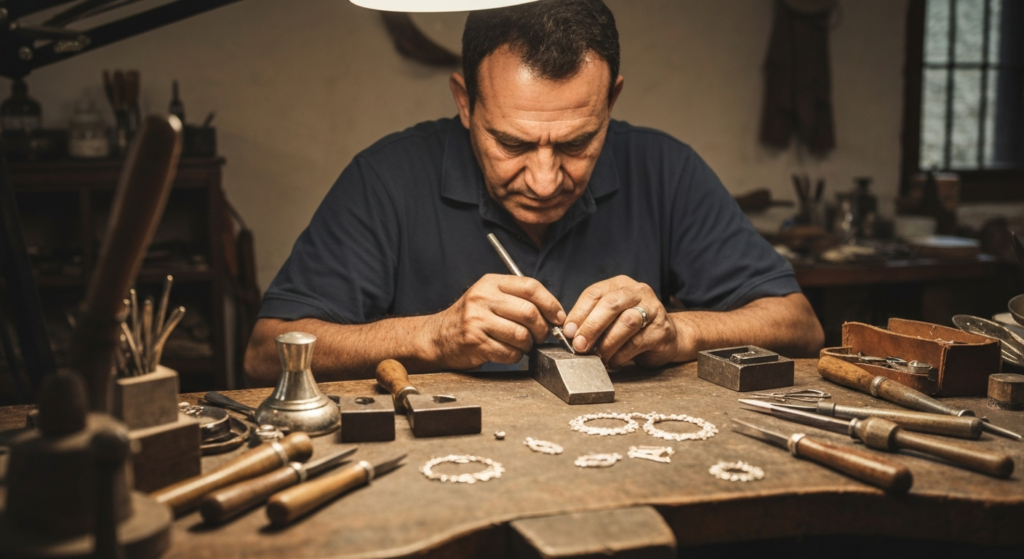
Filigree is perhaps the most iconic Balinese silversmithing technique, involving the creation of delicate, ornate designs from thin silver wire. The process begins with drawing sterling silver through progressively smaller dies to create wire as fine as 0.3mm diameter — thinner than a human hair. These wires are then twisted, curled, and shaped into intricate patterns that are soldered together to form elaborate openwork designs.
Balinese filigree is distinguished by its extraordinary density and complexity compared to filigree traditions from other cultures. Where Portuguese or Italian filigree tends toward larger, more open patterns, Balinese artisans create tightly woven compositions where hundreds of individual wire elements combine to produce surfaces of breathtaking intricacy. A single filigree pendant may require 6-8 hours of patient handwork by a skilled artisan.
The technique demands exceptional patience, steady hands, and acute vision. Our master filigree artisans have typically trained for 5-7 years before achieving the proficiency needed for export-quality work. This investment in skill development is why authentic Balinese filigree commands premium prices — and why mass production can never replicate its character.
Granulation — Spheres of Precision
Granulation involves the application of tiny silver spheres (granules) to a silver surface, creating textured patterns that catch and reflect light in distinctive ways. The granules are created by cutting silver wire into uniform tiny pieces, then melting each piece into a perfect sphere using carefully controlled heat. These spheres — some as small as 0.5mm in diameter — are then arranged in patterns and fused to the base surface.
The historical significance of granulation extends to ancient civilizations — Etruscan, Mesopotamian, and Greek goldsmiths practiced granulation thousands of years ago, and the technique was adopted and refined by Balinese artisans as cultural exchanges brought metalworking knowledge across maritime trade routes. Today, Bali is one of the few places where granulation is still practiced as a primary decorative technique rather than a historical curiosity.
Modern Balinese granulation builds on ancient foundations with contemporary applications — from traditional geometric patterns to organic, nature-inspired compositions where granules create textured surfaces resembling sea coral, flower centers, or clustered berries. This versatility makes granulation a valuable technique for wholesale collections targeting consumers who appreciate textural richness and artisanal detail.
Additional Techniques in Our Repertoire
Lost-wax casting (cire perdue) enables the creation of three-dimensional forms impossible to achieve through fabrication alone. Our artisans carve original models in wax with incredible detail, create plaster molds, burn out the wax, and pour molten silver into the resulting cavity. This ancient technique produces organic, sculptural pieces with dimensional complexity and surface detail that captivates consumers.
Repousse and chasing involve shaping silver sheet metal from both sides using specialized tools and hammers, creating raised relief patterns and three-dimensional forms without removing material. Combined with engraving techniques that cut fine lines and textures into the silver surface, these methods produce pieces with remarkable visual depth and tactile interest.
Contemporary techniques in our repertoire include precision CAD-assisted design, laser welding for micro-scale joining, tumble finishing for consistent surface quality, and electro-forming for lightweight hollow forms. These modern methods complement rather than replace traditional skills, expanding our design capabilities while maintaining the handcrafted character that defines Bali silver artistry.
Techniques at a Glance
Filigree
Intricate designs from fine silver wire (0.3-1mm). Produces lace-like openwork patterns. 5-8 hours per piece. Highest skill requirement. Premium pricing justified by labor intensity.
Granulation
Tiny silver spheres fused to surfaces. Creates textured, light-catching patterns. Ancient technique perfected in Bali. Combines beautifully with other techniques.
Lost-Wax Casting
Wax models converted to silver through mold-and-pour process. Enables complex 3D forms impossible through fabrication. Each piece starts as hand-carved wax original.
Repousse & Chasing
Sheet silver shaped from both sides with specialized tools. Creates raised relief patterns and sculptural forms. Traditional technique for dramatic dimensional pieces.
Oxidation & Patina
Controlled chemical darkening of silver surfaces. Creates contrast that highlights design details. Ranges from light antiquing to deep black finish.
Stone Setting
Secure mounting of gemstones using bezel, prong, or channel techniques. Our setters specialize in both precious and semi-precious stones across all setting styles.
WHOLESALE PARTNERSHIP
Ready to Source Premium Bali Silver Jewelry?
Join 500+ wholesale partners worldwide who trust Bali Silver Export for authentic handcrafted sterling silver jewelry. Direct factory pricing, 2,000+ designs, and dedicated account management.
Frequently Asked Questions
Which technique is best for my market?
It depends on your market positioning. Filigree and granulation appeal to consumers valuing intricate craftsmanship and cultural heritage. Cast pieces with bold designs suit trend-driven fashion jewelry markets. Minimalist wire work and clean forms resonate with contemporary design-conscious buyers. We help partners curate technique-appropriate collections for their specific markets.
How do techniques affect pricing?
Labor-intensive techniques like filigree and granulation command higher prices due to the time and skill required — a filigree pendant may take 6-8 hours compared to 1-2 hours for a simpler cast piece. We maintain transparent pricing that reflects actual labor investment, ensuring fair artisan compensation while enabling competitive retail margins.
Can you combine multiple techniques in one piece?
Absolutely — multi-technique pieces are some of our most compelling designs. A pendant might combine a cast base with filigree overlay and granulation accents, creating visual and textural complexity that justifies premium retail pricing. These combination pieces showcase the full breadth of Balinese silversmithing artistry.
How do I educate my retail staff about these techniques?
We provide technique education materials including photo documentation of production processes, descriptive product cards explaining the techniques used in each piece, and video content showing artisans at work. Partners can also arrange staff training sessions via video call with our master artisans who demonstrate and explain their techniques.
Are traditional techniques compatible with modern designs?
Completely. Our design team regularly applies traditional techniques to contemporary forms — filigree in geometric patterns, granulation on minimalist settings, casting techniques for modern sculptural shapes. This fusion of traditional skill and contemporary design is one of the strongest positioning advantages for Bali silver in international markets.
Start Your Silver Journey Today
Contact our export team for wholesale pricing, catalogs, and partnership opportunities.